A NOTE FROM RACHEL As always, Kevin and I want to maintain your interest--the recent revamping of the blog was done with that in mind. Providing consistent, engaging content has always proved a challenge, given the amount of time necessary to produce the reviews that are the mainstay of this blog. To do such reviews daily is easier said than done--I only have two hands, and there are only so many hours in a day. As a result there has been
far too much "lag time," and that stops now. It's unfair to you fans to not find something new and different every day.
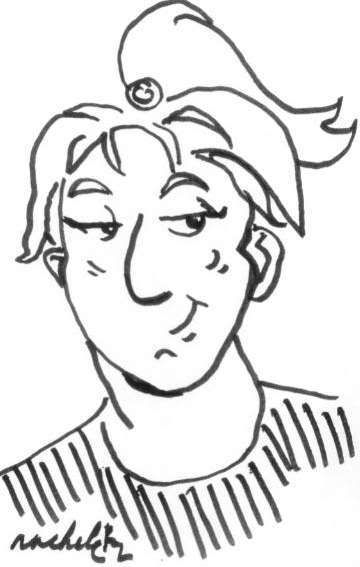
With that in mind, I'm inaugurating a new feature on this blog, or rather, the reworking of an old one. Kevin and I have in the past posted our personal correspondence here, but the constant switching back and forth between his comments and mine has no doubt confused and frustrated some of you. Therefore, from here on I'll be posting Kevin's comments--uninterrupted by me--in the form of a column called "Kevin's View." My answer will follow, in a section called "Rachel's Response"--also uninterrupted. You'll no doubt notice some other interesting changes. Whenever possible, pictures will be included to illustrate certain scenes we're discussing, whether stills from films or sketches by me. You'll also get to see, for the first time, what my "mysterious" friend Kevin looks like. He has given me permission to post his image--taken from his Cartoon Network stint--on the blog as his column header. With that, I'll let Kevin take it from here...
Happy 'Tooning,
Rachel Newstead
 Ah yes, the full outline of BOSKO'S EASTER EGGS was a fine enough surprise, the next best thing to having all nine BOSKO cartoons out on a comprehensive DVD set complete with commentary tracks--but isn't that what you are trying to do with this blog-give a kind of "commentary" on the cartoon while supplying descriptions of elements in each scene that are striking to the eye and should indeed be noted as people watch for the first or umpteenth time?
It is indeed interesting that both Bosko and Honey do show a great deal of personality in their body language and in the way the scenes are paced. This sort of experimental characterization is, perhaps, what might bug people about the HAPPY HARMONIES and,especially, the very expensive, expansive animation of the duo when they returned to MGM in1939, creating cartoons at MGM' s cartoon studio instead of their own, but it is true that the BOSKO toons are speedier than, perhaps, the entirety of the remainder of the HAPPY HARMONIES put together, although the Ising-directed TWO PUPS cartoons come in a close second in cartoons such as PUPS PICNIC and WAYWARD PUPS.
In BOSKO'S EASTER EGGS we certainly do get the best of both worlds here. We get the frantic hints of cartoon license with characters zooming this way and that in pop-eyed takes or trading dialogue as if we' d truly believe that the characters onscreen were merely drawn over live action footage of kids acting out each moment. Harmon &Ising liked using the "dissolve" a great deal more than most cartoonists. They liked using it instead of a camera pan across to the characters who would be in the same scene, whereas animators in other studios, including Disney, might just have the camera pan across to reveal something ominous approaching left or right of what was going on center-stage in the previous moment. Whether this was done as a time-saving chore or not, it is an odd visual to use.
Most of the time, such dissolves were used to represent passing time, but Harmon and Ising useit to give us the impression of how many things are going on at the same time in the same place, kind of like how the eye moves about a live stage as one scene begins taking our attention away from the previous moment of interraction. This effect has always gotten me thinking that, by now, we would have created an animated feature using multiple screens so audiences do get more of a dimension out of the images all around us. Why I was the only one, or so it seems, who got this idea is a real curiosity to me!
From reading this description, I also get the feeling that this is one of those few HAPPY HARMONIES in which two or more characters are interacting onscreen, a rare occurrence in decades hence as the effect certainly costs a great deal more to do, and I don't know what it takes for animators to synchronize the moves of two characters timing in a given scene together!! This may have led to some folks believing that Harmon or Ising used rotoscoping more than we suspected initially. There are some harmon/ising cartoons that bounce uncomfortably between total realism and cartoonishness, but there are others in which the link between the real and the surreal is startlingly accurate and the BOSKO cartoons are perfect examples of this, as you've outlined in earlier reviews.
It also should be pointed out that this cartoon is ultimately a cartoon about country kids living in farm areas where eggs were the source of food and vegetables grown from the ground also ended up on family tables. So barnyard gags like these went on all the time both in
real life and in so many cartoons that were inspired by farm living from day to day and, judging from the bulk of Harmon/ising cartoons of any age, I get the impression that the guys grew up in that environment.
So, at times, when compared to the SILLY SYMPHONIES, cartoons like this not only
work in showing an amazing range of character development, unfortunately at the point in which some characters were almost being phased out instead of further developed in future cartoons,
this ranks right up there among Disney' s best of this period. Although this is a HAPPY
HARMONIES title, usually full of cute little songs and singing animals or humans, this is clearly a situation comedy of sorts, making me wonder just what these characters would have been
capable of if used again when the duo returned to MGM after 1939. Let\rquote s not forget that
there were OUR GANG comedies to inspire the guys back then, and Hal Roach\rquote s
comedies were also at their peak, with some of the kids quite adept at pantomime and
double-takes of their own, even sometimes enhanced by animation to give the take that surreal edge within the live action framework.
As I've stated, you should read the Leonard Maltin/Richard Ban book, OUR GANG, THE LIFE AND TIMES OF THE LITTLE RASCALS to see what I mean. Read the full description of THUNDERING FLEAS for example, and then read through my outline of CIRCUS DAZE\rdblquote as found and dimly remembered on bcdb.com. I tend to think that CIRCUS DAZE was a cartoon only because one could not possibly put such situations into live action without people or animals getting seriously hurt!!
Lastly, I do, like you, wish that Honey continued on into the BOSKO TRILOGY, as we fondly have called the last three BOSKO musical titles with the jazzy frogs of THE OLD MILL POND and SWING WEDDING. Retaining Honey could have inspired many a musical number, like a jazzier Darla hood or something. The possibilities boggle the mind in retrospect! Makes me wonder why the duo weren't thinking with such clarity if I do say so myself.
Certainly BETTY BOOP cartoons had almost the same situations with Betty always launching into song even as she found herself in peril, and we loooved her for it. I wanted Honey to have as many delicious qualities about her, albeit more like Darla Hood, as I said, than curvaceous Betty. And they had enough talented kids at the studio at the time to give Honey just the right amount of everything I' ve outlined here. It is nice that you again point out Honey' s chattering in surprise, awed by every moment in a given scene, adding something wonderful to her character. I love the moment in which she is going on about how beautiful the newly born chicks look ("d'ere' s a green one an' a blue one an'...d' ere' s one all polky-dotty...") It is a character trait that not only toys with dialect but defines a certain part of this country very clearly. It is that type of humor so misunderstood today and misused by those who wish to stereotype rather than understand its source of inspiration.
RACHEL'S RESPONSE
Kevin's OUR GANG analogy perfectly describes the nature of the Bosko cartoons, as if
Buckwheat had been spun off as an animated character to appear in a series of "adventures" of
his own, but truthfully, the Bosko cartoons transcended race, becoming instead something in which people of any race can find common ground. Perhaps without realizing it, Harman and Ising had unlocked the secret to what made the OUR GANG films so special in the Hal Roach era: "real" stories about "real" kids. While both the Bosko cartoons and the OUR GANG films would climax in cartoonish insanity, the kids seemed like kids, doing the things kids do, if in a somewhat exaggerated way: going to the circus, fending off hostile, recalcitrant creatures both large and tiny, and getting into general mischief, as Bosko did in BOSKO'S EASTER EGGS.
That MGM acquired the rights to OUR GANG in 1938, just a short time after Harman/Ising's days at the studio ended, is a tragedy of missed timing.
The two series would have complemented one another perfectly, with the animated version perhaps looking a bit better in the bargain. Bosko could have gained other kid friends--perhaps a little brother (though I consider the "L'il Ol' Bosko" of the Jazz Frogs Trilogy to be a "little brother" of sorts to the original version) while Honey could have stepped into the Darla Hood role in more ways than just musically. Darla, like most of the girls one saw among the gang, usually existed as a complication to the boys' schemes--disturbing the boys' "paradise" of the He-Man Woman Hater's Club, for instance--and Honey could have adapted to play a similar role. If anything, it might have worked better with Honey, since the character's personality was more clearly delineated than Darla's.
Hugh and Rudy indeed knew the rural sections of the country well, and how rural people behaved. And well they should, as they--like Walt Disney--were Kansas City boys (an aspect I shamefully neglected to mention in Sunday's review).They reveled in bucolic cartoons--whether broad, impossible slapstick like the earliest Oswald and Mickey silents, or gentle with moments of broad humor, as in the Bosko cartoons. Their celebration of nature led to cartoons like THE BLUE DANUBE and TO SPRING, both an explosion of realistic beauty and color. Those who dismiss such cartoons as slow and cloying have to understand Hugh and Rudy's background--they wanted to share the natural beauty they remembered with the public. It's a love that should resonate in the minds of the environmentally-conscious young people of the 21st century. Harman and Ising portrayed a world they feared was rapidly disappearing.
They did go through something of an awkward "adolescence" during their first years at MGM,
shifting uncomfortably sometimes between their earlier, cruder style and the gentler, more
"realistic" one. In some cartoons it actually added to the sense of enjoyment, as shorts like
CIRCUS DAZE shift back and forth between near-realism and bug-eyed cartoony takes. Yet in
films in which they tried to be "serious", as in TALES OF THE VIENNA WOODS, they'd fall on
flat on their faces, as their ambition far outstripped their artistic ability. I've included some
samples here to show what I mean:
In the opening seconds, the view dissolves from an almost perfectly-rendered realistic drawing of a fawn to a rubber-limbed, round-headed, goggle-eyed creature that wags its tail like a puppy. It wouldn't have looked too out of place in a 1932 Looney Tune--in the span of a second or two, we're suddenly back in "rubber-hose" territory, and it comes close to destroying the mood of the film.
During that rough "shakedown" period, they resorted to some pretty ingenious ways to hide any artistic shortcomings. It's no  accident that many cartoons from that era featured toys as main
characters, as in THE CALICO DRAGON, THE OLD PLANTATION, and TOYLAND BROADCAST.
The last of the three takes place in the realistic surroundings of a child's bedroom, but one in
which the child is nowhere to be seen. The little girl in the opening moments of THE CALICO
DRAGON by necessity takes up very little screen time, as it was clear they were still not quite
sure how to portray a human child realistically. As one can see from the image I've included, she
seems almost as doll-like as her toys:
By using characters that were meant to be "unreal", such as toys, Harman and Ising could use
characters equally at home in realistic surroundings or worlds of pure fantasy. Once they found
their artistic footing, such devices were no longer necessary; though they did use their ability to
combine the broad with the starkly real in PEACE ON EARTH--a cartoon meant to be emotionally
jarring, yet a fine example of their artistic "maturity."
When Kevin wrote of Harman and Ising's use of the "dissolve" as a storytelling device, I
immediately began to wonder: were they indeed the first to use "montage" in animation (the term I think Kevin was searching for) rather than Frank Tashlin, as generally believed? I couldn't come up with any evidence of their use of such a technique before Tashlin, but they do come close in CIRCUS DAZE. Though in fact, the opening scenes were more a series of rapid successive dissolves than a true montage. We move between nearly-overlapping shots of a
"test-your-strength" meter, to a dishonest hot-dog vendor, to a charging elephant, to a laughing
clown. While not strictly montage, it serves the same purpose--establishing the atmosphere and
the premise quickly so we can get on with the story--yet more proof their cartoons were not
agonizingly slow.
How, then, could anyone say these men lacked creativity, imagination, or humor?
Tags: Harman-Ising, Kevin+Wollenweber, Rachel+Newstead, Kevin's+View, Rachel's+Response, Bosko+and+Honey, Our+Gang, Leonard+Maltin
Tuesday, April 10, 2007
Kevin's View: The Worlds of Hugh and Rudy
Sunday, April 08, 2007
"De Easter Time Is De Time For..." BOSKO'S EASTER EGGS (1937)

Bosko's Easter Eggs
Release Date: March 20, 1937
Director: Hugh Harman
In short: Honey plays "mother hen" both literally and figuratively, while Bosko "hatches" a plan for her Easter present...
It's Easter here in Wisconsin--meaning that as little children gather their eggs, they have to brush off the snow.
Yet it is Easter, even as the last remnants of winter hold tight. A time for bright colors, to marvel at the wonder of renewal. A time for...cartoons.
Well, not that, perhaps. But we take a little diversion from our scheduled program to uncover this Easter surprise from 1937, featuring Harman and Ising's greatest creations, Bosko and Honey.
As I've often said, both privately and on this blog, Honey is my favorite character of the two, for the simple reason that she had the most personality. Bosko, however, comes into his own in this
cartoon, revealing a mischievous, devious side not typical of him. How shall I put this? For now,
let's just say he concocts a "creative" scheme to acquire an Easter present for his friend Honey.
How? Read on...
The MGM lion and opening credits dissolve to the title, in which the letters look as if they've been
"painted" in Easter colors, with the paint still dripping off them. We iris in on Bosko (in his now-trademark overalls and straw hat) walking down a country pathwith trees and spring flowers in the background. Bruno follows close behind, sniffing along as he
goes. As should be familiar to anyone who's seen the MGM Boskos, Bosko chants in rhyme:
"I'm takin' Honey some Easter eggs, An' de basket's full, if dey don't drop out, I'll step real soft so de shells won't crack, If she don't like 'em, I can take 'em back!"
This little rhyme, combined with Bosko's surprisingly mature voice (more fitting for an adolescent, really, than a child) illustrates his newfound cockiness, as does the myriad expressions he exhibits in freeze-frame: jutting out his lower lip and breaking into his ever-present grin.
Immediately after he finishes speaking, he trips, falling on his rear and causing the basket to land on its side, just to his right. The eggs are unharmed, though a few roll out of the basket. Rising to his feet, he turns to the right, puts his hands on his hips, and addresses Bruno (off-camera):
"Doggone you, Bruno! How come you always gotta stomp so much?!" (Fairly quick to pass the
blame, he is--which will land him in more than a bit of trouble later on). "Now you come on!"
Placing his straw hat back on his head, he grabs the basket and resumes his rhyme:
"Now I'm takin' Honey some Easter eggs,
An' de one is green, an' de other blue.."
Meanwhile...the scene dissolves to reveal Honey, in her ever-present yellow dress, crouched on
her knees to the right of the screen. She's in a chicken coop--we see her pet hen, Biddy, on the
left of the screen hatching a nest full of eggs. "C'mon, Biddy! Drink!" Honey urges, leaning forward slightly on the word for emphasis. "Like this..." She proceeds to demonstrate for Biddy, putting her head down in the hen's water dish and miming drinking, in the manner of a chicken: taking a small sip, then putting her head back, "swallowing" in short gulps. Biddy follows her lead.
"That's it!", Honey says. Turning, she grabs an ear of corn and starts to scrape kernels from the
cob onto the ground, being her usual chatty self all the while. "Now I'm gonna get you some nice corn, and you're gonna set real still, an' you're gonna hatch out a whole bunch of little Easter chickies!" (On the words "whole bunch," she spreads her arms in the air). "Now you be sure toset right tight on them eggs," she continues, moving to the left. She stands just outside the open coop, leaning forward, hands on hips, still chattering as the scene dissolves.
We return to Bosko, still walking along and chanting in rhyme. In the background are trees and a small creek:
"Now de Easter time is de time for eggs,
An' de time for eggs is de Easter time..." As he speaks the second line, he walks up a plank to the top of a picket fence, as Bruno follows
along on the ground just to his left. Gingerly stepping along as he dangles the basket precariously on one arm, he continues his chant:
"an' I pray de Lord,
as I climb de fence,
Dat I ain't gonna tear my Sunday pants!"
 Unfortunately, tearing his pants turns out to be the least of his worries, as he trips on a
fencepost, sending him reeling backward and causing him to let go of his precious basket of
eggs. He lands right on the basket, crushing the delicate eggs and flipping the basket up in the
air. It lands--straight down on his head. He sits covered in the messy remnants as they run down his entire body. (Word of advice, Bosko--you might try boiling them next time before you color them).
The scene cuts to Bruno, about to get into a tussle with Biddy, who's understandably protective of her eggs. Bruno is crouched as if to spring on her--he doesn't, however, instead panting happily. He wants those eggs! Biddy knows he does, and grows ever more agitated, jumping up and down and lunging at him. As Bruno sniffs and smacks in anticipation, Biddy grabs his nose and pulls it, stretching it like a rubber band. It reacts like a rubber band, too, snapping him back several feet, causing him to run into a barrel. He gets up and runs off camera right, yowling.
Bruno, still looking behind him, runs past Bosko, who's just now removed the muck-filled basket
from his head. Bruno bumps into him as he runs by, forcing Bosko's face back into the mess.
(Isn't it strange how clean Bosko's clothes are, considering that a moment before he was sitting in crushed egg goo? I want that material!)
"Doggone, Bruno! Now see what you done!" (That's right--blame the poor defenseless dog. Just
who was it on that fence, hmmmm?). "You ruined the Easter time!" As Bosko continues to berate him off camera, we see Bruno--with a forlorn expression--emerging from a clump of plants and weeds near a broken part of the fence. He cowers, putting his paws over his head.
Bosko starts to speak (it sounds something like "Now I've not got de...") only to cast a startled
glance off camera. His expression instantly changes to glee, and he snaps his fingers. Care to
guess what he sees? He starts to creep slowly forward, saying "De Easter time is de time for..."
Cut to Biddy on her nest as Bosko emerges from the right of the frame, standing just outside the
entrance to the chicken coop. He cranes in for a look--in his mind, Biddy disappears to reveal a
nest full of...brightly colored Easter eggs! He's got Honey's present after all--even if it is her own
eggs.
He struts by carrying his empty basket--now curiously free of egg remnants--past Biddy,
pretending to be nonchalant. He turns to face Biddy, pouring on the phony charm:
"Why hello, Miz Chicken! You sho' is lookin' mighty scrumptuous today!" He walks back toward
the right of the screen, Biddy following his every move. He leans forward and winks at Biddy. He looks back and forth, then back toward Biddy: "Well! Just look at all dem eggs!" he says with a
back-and-forth emphatic gesture of his arms, and a sly grin on his face. "You sure is powerful
uncomfortable sittin' on all dose eggs...now you just better let me kinda get in here and help
you..."
As he's saying this, he slowly picks up the basket with his right hand and reaches in for the eggs
with his left. Biddy will have none of it--she leaps up in the air and lunges toward Bosko, sending
him out into the foliage. He moves so quickly, all we can see of him is a red streak. (A speed
trick Harman and Ising have used with Bosko before, most notably in THE OLD HOUSE).
The camera follows him toward the right as he continues running, gradually slowing down when
he's a safe distance from the furious Biddy. He walks a few more cautious steps and turns about,
repeating his earlier rhyming refrain: " De Easter time is de time for eggs, and de time for eggs is
de Easter time..."
Cut back to Biddy on her nest, who's settled back in and calmed down somewhat. Bosko
approaches from the right of the screen, tiptoeing along. Apparently slow to learn, Bosko repeats his "Hello, Miz Chicken!" routine (pardon my cynicism, but this may have been an excuse for
Harman to reuse the animation of the earlier scene).
But this time, our friend Bosko has a slightly different plan in mind. Grabbing the ear of corn
Honey discarded earlier, he says, "How 'bout you eatin' some of dis here corn, and makin'
yourself all nice and fat...." As he says this, he walks along toward camera left, scraping off corn
as he goes. He launches into his "Easter Time" refrain off-camera as Biddy gobbles up the kernels of corn.
Bosko continues his refrain as he heads toward a chicken-wire pen:.."and do you know what I'm thinkin' when, you get locked up in de pen!" He sets down the ear of corn, moving slowly to the right of the screen as Biddy passes him in the opposite direction, still intent on getting the corn. If she only knew what was coming!
Biddy jumps up as she hears an off-camera door slam--she's been tricked! Jumping up in the air, she speeds toward the now-locked door. Unable to find a way out there, she runs here, there and everywhere around the pen searching for a way out. Meanwhile...
The scene dissolves to show a close-up shot of a basket filled with colored eggs--Biddy's eggs!
The camera pans right to show Bosko hastily painting an egg bright red while repeating his
"Easter Time" chant. On the words, "de time for eggs is de...," he very nearly loses his grip on
the egg he's just painted, tripping and bobbling it as he goes to the basket.
"Easter time..." he says with a sigh of relief, as he approaches the nearly-full basket.
As he walks along carrying the basket on his left arm, he continues:
"An' I pray de Lord,
Dat de pen hold tight,
Fo' if she get loose,
She'll cook my goose!"
Seeing Honey off-camera, he calls to her: "Honey! Oh, Honey!"
We dissolve to Honey, who's holding a watering can and watering some flowers. Pleasantly
surprised, she turns to Bosko, who has just emerged into the right of the screen with the
disguised basket of purloined eggs. "Bosko! Fo' me??" she says.
Holding the basket high above his head--you'd think he'd learn not to be so careless--he says,
"Yes, fo' you!" Leaning forward and clasping her hands under her chin, she gushes, "Bosko, I
think dey is just ab-dominal!" (An expression of hers almost common enough to be a catchphrase by this time). "Where did you get these love-" Before the last word even comes out of her mouth, she imagines Biddy perched on top of the
eggs. Her expression changes from shock to suspicion to anger: her fists clench.
Cut to a close up of Honey, leaning forward, hands on hips: "Bosko...where did you get dem
eggs? WHERE DID YOU GET DEM EGGS?"
When she says this the second time, we cut to Bosko, cringing, with his head turned away.
"W--w-w-well, I j-j-just passed by..." he stammers, pointing in all directions.
Cut to a medium shot with both Bosko and Honey in frame. "Yeah, passed by and an' took poor
Biddy's eggs--that what you done!" Her expression changes to sadness.
Suddenly, the eggs in the basket start to jump around as we hear a tapping noise. The eggs are
hatching! Running around and becoming frantic and flustered, she shouts, "Oh, Bosko...the eggs!
Hurry, quick! Poor Biddy.." Grabbing Bosko by the arm, she takes him and the basket of eggs
toward the coop. We view them standing just outside, from the coop's darkened interior. Bosko, unfortunately, has neglected to tell her he locked Biddy up. Noticing the empty nest,Honey looks toward Bosko, who grimaces.
"Oh, she's gone!" Honey exclaims. "Now Biddy's done left the maternity ward (I always liked this line!) and dem eggs are getting cold..."
Bosko, being even more agitated then Honey (not to mention guilty) hops back and forth on one foot, then the other, stammering, "p-p-put the eggs on the nest. Bruno'll keep them warm!"
Cut to a very worried Bruno, who's been standing next to the plank at the end of the picket fence (the same one Bosko had climbed earlier, just before he broke his own eggs). Bruno looks off
camera left with a worried expression, and tries in vain to sneak away.
Bosko comes into frame and grabs Bruno's collar, dragging Bruno toward the coop. "C'mon,
Bruno--you is gonna be a mama!" Dissolve to Honey crouched on her knees back in the coop, placing the now-multicolored eggs back on the nest. "De very idea..." she mutters, then starts chattering angrily in rapid-fire dialogue that's incomprehensible to me. Bosko emerges from the right, still dragging Bruno. He places the struggling dog on top of the eggs, saying "Come on, Bruno--easy now--that's it!"
Honey emerges with some clothing, placing it on Bruno as he fights to get away. "Here now, you get this here...bonnet on...and this here shawl! (I've heard of "method acting", but this is ridiculous). "And come quick, Bosko! Let's find Biddy!" She rushes out, disappearing to the left of the frame. Bosko in freeze-frame has a big wide grin on his face--he's clearly delighted with either his own cleverness or Bruno's plight. Poor dog.
As a parting shot to the mortified Bruno, Bosko says, pointing his finger at him, "Y-y-y-we made the bed--now YOU lay in it!" That pretty much seems to be Bosko's philosophy in this cartoon, if his actions up to now are any indication.
Honey re-emerges, grabbing Bosko by the arm--the camera tracks to the left, following Honey as she pulls Bosko along. "Come on Bosko--hurry!"
Cut to the pen, where the frustrated Biddy is still trying to find a way out, jumping and squawkiing madly. She succeeds, heading through an improbably small opening. Hopping mad, she looks frantically around and heads back in the direction of the coop, camera right. Cut to a very depressed Bruno, still on the nest. Even the sound track mocks him, playing an old song (which I think is called--and you readers are free to correct me if I'm wrong--"My Dear
Mother.") He snuffles in self-pity and puts his paw under his chin. (Note: the version I'm using in this review, taken from YouTube, seems to cut some brief sections out. As I recall, Bruno
incongruously speaks here, as he did in THE OLD HOUSE).
Here--finally--the action starts to soar to CIRCUS DAZE heights as Biddy returns. Discovering Bruno on the nest, she proceeds to chase him around the coop and out into the yard, chasing him first toward the right, then wheeling around and chasing him toward the left. In freeze-frame one can easily see Bruno's wide-eyed panic as he scrambles to get away, Biddy equally wide-eyed as she flutters in the air directly above him.
Cut to Bosko and Honey, still running along, skidding to a stop as they hear the commotion.
Honey says what sounds like "Bruno! Biddy!" as she runs out of frame to the right. In the
meantime, we cut quickly back to Biddy chasing Bruno--she chases him toward a shed, grabbing him by the tail as he struggles to wiggle into a small hole at the bottom. Noticing Bosko just
behind her, she turns and stalks him. Stammering, the panicked Bosko runs as the camera pans
right--he's barely ahead of her, yelling "Miz Chicken! Miz Chicken!" Honey, back at the nest, is busy putting a hot water bottle on the multicolored eggs. A teakettle--an incredibly large one, at least in proportion to her--sits at her right. Honey gently pats and arranges the eggs under the bottle.
Meanwhile--again--Biddy is still chasing Bosko, around a wooden structure that looks somewhat like a roof with no building. Bosko stammers, pointing: "Y-y-y-LOOK!!" Biddy does--her attention momentarily diverted, Bosko runs off-screen to the left. When Biddy discovers she's been tricked, she exits in close pursuit.
Cut back to Bruno, still trying to get into the tiny hole in the shack--but he's stuck, only managing thus far to get his head in. Bosko attempts to pull him out by grabbing onto one of the yelping Bruno's hind legs. He doesn't manage to accomplish much, as he spies Biddy off-camera to his right and runs as fast as he can in the opposite direction.
The scene makes a quick cut to the shack's front entrance as Bosko runs into frame and
scrambles inside, slamming the door. We can still hear Biddy squawking off-camera. The now
discarded paint cans--the ones Bosko used to color the eggs--can be seen just to the left.
Biddy comes into frame, turning toward the front entrance. But she runs straight into the door,
failing to notice Bosko had just closed it. As she hops up and down, angrily squawking as
usual...
...we cut to the darkened interior, where Bosko attempts to pull Bruno inside. From the scattered assortment of junk inside, my guess is this shack is a tool shed.
Bosko, unsuccessful in trying to free the stuck Bruno, gets thrown back by the momentum of his
pull, hitting a wooden box. Getting up, he resumes his attempts to work Bruno loose. The action
starts to get really furious here, and the background music speeds up to keep pace.
Pulling Bruno by the ears(!) Bosko succeeds in getting Bruno free, throwing them back toward the wooden box--Bosko on top, Bruno draped over the edge. We cut to a quick shot of the hole, with light streaming through, then back to Bosko and Bruno, who stand up on either side of the box, waiting for Biddy's inevitable approach.
Bosko and Bruno start to push the wooden box toward the empty hole, thinking they'll keep the
enraged Biddy out. Little do they know that Biddy has somehow sneaked in right behind them...Bruno, when he turns and sees her, explodes in an almost Tex Avery-like take, tensing his body ramrod-straight, turning to face the camera and falling in a dead faint. It's a pretty faithful reproduction of the classic slapstick "stiff-legged fall" from the Mack Sennett days.
Bruno doesn't stay out for long, though, speeding past Biddy and attempting to crawl out through another hole on the other side. (So THAT'S how Biddy got in). Biddy flaps and squawks in the air, feathers flying.
Cut to the outside. Bosko tugs on Bruno's ears--again--this time pulling him free with such force
they get propelled backward through the air into a bucket of water. The cloud of dust settles to
reveal Bruno has the bucket stuck on his rear, but he goes into a furious run anyway. Bosko in
the meantime attempts to hold on to Bruno, still by the ears. As Bruno runs along, Bosko bumps
up and down behind him. In freeze-frame Bruno's mouth is wide-open in panic as he looks
off-camera toward the pursuing Biddy.
Bruno, with Bosko and the bucket still in tow, skids on his rump 180 degrees and heads off in the other direction. They pass behind a tree just as Biddy passes it from the other side.
As Bosko and Bruno continue running, Bruno manages to free himself from the bucket, but in
doing so, he and Bosko are sent tumbling toward the coop where Honey awaits them. The
startled pair duck inside just as Biddy approaches from the left of the screen and passes the
coop entrance.
But before Biddy can attack either one of them, she's startled by the sound of one of the eggs
breaking open and the peep of a newly-born chick. Yet it seems to be a strange color...
"De Easter chickies!" Honey exclaims. "Oh, Biddy, look--isn't dey simply 'magnolious?' Dere's a
blue one, an' a green one, and ain't dey just simply..." She continues to chatter excitedly in her
typical Honey way as the chicks continue to emerge. She's absolutely correct--Bosko's earlier
paint job has somehow produced a nestful of Technicolor chicks--some even polka-dotted. "Oh,
Biddy--now we got a whole bunch of little Easter chickies! And oh, they're so CUTE..."
Biddy, though, hasn't forgotten about Bosko and Bruno's interference, and shoos them both off
with a squawk, sending them both toward a pile of straw, underneath the empty basket. Bosko
peers out, and emerges resuming his "Easter Time" refrain:
"Now de Easter time is de time for eggs,
But--
--de hen got loose and cook our goose!"
Bruno, who has emerged beside Bosko in the haystack, pants happily as we iris out. Honey got
her Easter present after all, far better than the one Bosko planned to give her.
CONCLUDING THOUGHTS
(This section edited, in recognition of those who may not celebrate this holiday. Nonetheless, we hope you enjoy this cartoon as much as Kevin and I).--R.
This cartoon is a delight, possibly the pinnacle of Harman and Ising's achievements. It gives lie to the oft-repeated complaint that Harman-Ising's cartoons are slow and plodding. In many places it explodes with action, more so than any since CIRCUS DAZE. True, at nearly eight minutes, the cartoon could have done with a little tightening here and there--some sections seem unnecessarily padded (as in Bosko's "Hello, Miz Chicken" bit) but there's one thing that must be understood about Harman-Ising.
They were never uniformly, unrelentingly slow. Their cartoons, especially the Boskos, would start slowly and build to a crescendo of action, with overlapping scenes and quick cuts that take place in such rapid succession one needs the ability to freeze-frame to take them all in. This, most of all, is what they took from Walt, possibly even surpassing him. The last third of this cartoon is indeed a blur, as Honey scrambles frantically to rescue the eggs (her panic recalls classic TV "birth" episodes, as in I LOVE LUCY and THE FLINTSTONES) while Bosko and Bruno furiously attempt to outrun an enraged hen.
Indeed, BOSKO'S EASTER EGGS destroys yet another myth, that of Harman/Ising's alleged
bland characterization. Leonard Maltin has this to say of the personality animation in
Harman-Ising cartoons--or in his view, the complete lack of it:
"Engaging visual designs cannot take the place of stories and
characterization. Personality animation is a notable achievement,
but not when every personality is the same." (Of Mice and Magic, p. 282).
As should be clear from the examples I've provided in this review, Maltin's statement is utterly
false. Honey, when she discovers Bosko has not only stolen Biddy's eggs, but painted them and
tried to pass them off as his own present to her, registers a full range of emotions--through her
facial expressions and body language--in a few short seconds. Even without dialogue, her feelings are clear. When Bosko grimaces, he does so with his whole face, as his eyes squint tight and his lower lip looks as if it's come up to meet his nose. His pain and guilt are clearly evident. In countless scenes one can see expressions of bug-eyed, almost Avery-like slapstick panic. This was far beyond the abilities of most animators of the day, save for those at Disney--and even they might have had a few things to learn from Harman and Ising.
Bosko certainly exhibits more personality in this cartoon than he was typically allowed to do.
There's some thinking going on there, as he schemes to gain Honey's favor. He's more "kid-like"
than he had ever been up to that point--not to mention cocky--childishly passing on the blame for his own mistakes and acting quite selfishly. He would never have resorted to such behavior
before, and would never do so again. After this film, he would be "made over" yet again, into the
"L'il Ol' Bosko" of the Bosko Trilogy--a happy innocent barely past toddlerhood.
For once, Honey does not take center stage--most of the cartoon either revolves around Bosko's
schemes or his attempts to elude the hen--yet she retains her role of "friendly antagonist" to
Bosko, even acting as his conscience in this cartoon. She carries over her bubbly,
chatty personality from earlier MGM efforts, but she is obviously more mature than the
irresponsible, careless and even insensitive Bosko (think what he does to poor Bruno, not to
mention Biddy). As such, even she comes off as a more dimensional character than usual.
BOSKO'S EASTER EGGS represents both at the peak stage of development.
The voices, of course, contribute greatly to the characterization, particularly Bosko's, however
incongruous it may be for a child of his supposed age. (I assume about eight or nine). The reading of the lines, and little touches lke Bosko's nervous stammer, enhance the already masterful personality animation. The voice actors were apparently uncomfortable with or unaccustomed to speaking in dialect, at times slipping out of it. As such, it's not nearly as obvious as in, say, THE OLD HOUSE or CIRCUS DAZE. Honey's malapropisms come across as more an element of her personality than the manifestation of a stereotype.
Sadly, this cartoon is the last we'll ever see of poor Honey--Bosko goes solo in his three final
appearances. Perhaps it's better that way, as BOSKO'S EASTER EGGS is more than a fitting
exit for her. As the old show business saying goes, "Always leave 'em wanting more."
Kevin and I have discussed this cartoon frequently in the past, as Kevin's childhood memories of it have faded, and he ached for the chance to re-experience certain scenes. He has on several
occasions wished for a complete synopsis of the cartoon, which I've never been able to give him
until now. I haven't any multicolored chicks, so this is my Easter present to him.
And a happy Easter--to those who celebrate it-- from the "staff" of The Home For Orphan Toons. To the rest of you, we wish a most bright and bountiful spring season.
Rachel Newstead
Kevin Wollenweber
Alicia Wishart
Tags: Bosko+and+Honey, Harman-Ising, Easter, eggs, chicks, hen, Bruno, racial+stereotypes, orphan+toon, review-synopsis
Friday, April 06, 2007
Technorati Knows Me! (AKA My Most Humble, Groveling Apologies)

I know, I know. "Where's the review for THE POWER OF THOUGHT? You promised a 'double bill', and we're gonna get one!"
Well, first I had to succumb to the power of sleep. The previous review took fourteen hours of non-stop work, I'll have ya know--and I had errands to do the next day. All told, I was awake a total of 29 hours: a feat I haven't successfully accomplished since my late teens, and I hope I'll never be challenged to break that record. It's taken the better part of two days for my body to recover--now that it has, on to business.
Remember the horrible things I said about Technorati? Well, I hereby officially retract all previous insults: at least until something else goes wrong, that is.
Hallelujah, it works!
After spending about half of yesterday redoing all the tags, I find this morning that all that work wasn't necessary: I awoke to discover the blog had indeed been updated, and found this letter from Technorati Support:
Hello Rachel,
Please accept my sincerest apologies for the delay in getting back to you. We've been experiencing a backlog in support and are
working hard to address everyone. I've taken a look at the issue regarding picking up your pings for "orphan-
toons.blogspot.com". After making a small adjustment, I've sent our spiders to revisit your page and your blog should be indexed
successfully from now on.
Please let us know if you experience any problems in the future. Do not hesitate to contact me if you have any other questions.
We apologize for any inconvenience. Thank you for using Technorati!
Best Regards,
Janice Myint
Customer Support Specialist
Technorati
(Customer Support Specialist? Is it just me, or is everybody a "specialist" these days?)
My profuse thanks, Janice--though it would have been nice to know what the "small adjustment" you made was, so I could make it myself if this ever happened again. I don't know if you noticed, but you folks aren't the easiest people to reach.
Moving on:
Like my new avatar? It's supposed to be a self-caricature, but to be honest, it doesn't look like me. I look worse.
I figured a drawing might be easier for you folks to take than an actual photograph...anyway, after not drawing for so many years, I felt it was time to re-establish my cartoonist creds.
Now if you'll excuse me, I have to go watch two cartoon magpies outwit a bulldog...
Tags: Technorati, support , apology, avatar
Tuesday, April 03, 2007
A Terrytoons Double Bill (Part 1): THE MAGIC PENCIL (1940)

The Magic Pencil
Director: Volney White
Music: Phillip Scheib
Release Date: Nov. 14, 1940
Before Heckle and Jeckle, before Mighty Mouse, and way before Deputy Dawg, there was Gandy Goose. For those who can remember seeing Terrytoons on television or in theaters--in vibrant color or grainy black and white--he hardly needs an introduction. But he does need a home, and has found one here at The Home For Orphan Toons.
Foolish but possessed of a wild imagination, his strange dreams provided fodder for most of his appearances. He was certainly the most promising character Terrytoons had created up to that time--before his first appearance in 1939, Terrytoons really had no star characters to speak of--unless you consider Farmer Al Falfa or Kiko The Kangaroo "star characters."
Though THE MAGIC PENCIL was not Gandy's first cartoon, it was the first to team him with the Durante-ish Sourpuss, a minor character previously seen in the color "one-shot" THE OWL AND THE PUSSYCAT. Say what you will about Terry, he knew a good thing when he saw one--and they remianed teamed for the remainder of their appearances (including a series of army adventures during WWII).
Like many cartoon characters of the classic era, Gandy's personality was "borrowed" from a radio comedian--in this case Ed Wynn--but whether entirely original or not, I must admit I have a soft spot for the little goofball. (According to the mostly reliable Leonard Maltin, Gandy's voice was provided by Wynn imitator Arthur Kay. I'll explain the "mostly" later on...)
Onetime Terrytoons employee Ralph Bakshi apparently had fond memories of Gandy as well: Bakshi's "Mighty Mouse: The New Adventures" series in one stroke parodied not only Gandy, but Marvel's revised Captain America origin story from the '60s. In the cartoon, Gandy is thawed out after having been frozen in an iceberg since World War II (like Cap) and has a little difficulty adjusting to the present, spending most of his time pining for his lost sidekick (also like Cap).
You might want to check out the copy of that particular episode ("The Ice Goose Cometh") on YouTube as a sort of refresher course.
Back already? Great. Then without further delay (I hope) I present to you THE MAGIC PENCIL:
The copy I was able to obtain (courtesy of Jerry Beck) was taken from a 16mm release print intended for home movie projectors. As such, there are no animator credits in the opening titles (there may not have been in the original print, but I have no way of knowing.) We open with a still of our "star", Gandy, with his name superimposed, which immediately dissolves to the title.
References to 20th Century-Fox, the studio's distributor, have been edited out, blacked out, or both.
We open with Gandy listening to lively swing music on the radio, clapping along and doing a silly little tap dance. The camera follows Gandy as he dances to the left, right in front of Sourpuss, who is seated and trying to read a newspaper. Annoyed at Gandy's noisy tap-dancing, he puts the paper down and yells "Quiet!" Sourpuss is a black cat with a white face in this cartoon, quite different from his appearance in the color cartoons of this period. In those, his head and ears are a pale brown and his face a sort of beige.
Sourpuss kicks Gandy across the room toward the radio--Gandy bumps into it, knocking off the flowerpot perched on top. It falls, hitting Gandy on the head, which stuns him: his eyes cross a bit. (Kind of a natural expression for him, at that).
The music stops, and we hear an announcer's voice: "This is station W-A-K...now remember, boys and girls, all you have to do is send in 2000 box tops, and ten cents, and you will receive a magic pencil." The scene shifts to reveal the announcer in front of the microphone--a portly fellow with slicked hair and a pencil mustache. Sort of an Oliver Hardy type: he even has the same delicate gestures as Hardy--rather fey. He's holding the aforementioned pencil, which doesn't look all that "magical" at first glance. But this is a cartoon, after all...
Cut back home to Gandy, who says to the disembodied voice on the radio, "Did you say a magic pencil?"
The announcer replies "Yes, a magic pencil." (Why was that gag funnier when the folks at Warner's did it?) Gandy yells "Oh boy!", pumping his fists in the air.
We cut to a shot of the kitchen cabinet, which Gandy approaches from camera right. He pulls out a sizeable pile of cereal boxes and starts tearing the box tops off furiously, flinging them behind him. (Wait..that little cabinet can hold two thousand cereal boxes? What is it, a portal to another dimension? More importantly, where can I get one like it? The storage space in my apartment is pathetic).
The scene dissolves to show Gandy walking along carrying the enormous bundle of box tops: some in his arms, some on his head, some on his feet, and even a few on his feathered rump.
Cut to a shot of the radio--as Gandy approaches from the left, the radio starts to suck the box tops through its speaker, as if the speaker were a "mouth". Come to think of it, the radio does look vaguely human--it's one of those console types with two knobs at the top and the speaker at the center, and resembles a "face."
We cut again to a shot of the radio station and the Hardyish announcer. He's immediately splattered with Gandy's box tops, which come at him from the microphone as if they were playing cards flung in his face. They fall all around the announcer and scatter on the floor. The scene changes to a close up of the genial announcer, who says "Thank you!"
"And here is your magic pencil," he says. To a "boing" sound on the sound track, he reverses Gandy's little trick, shoving the pencil through the microphone, causing the mike stand to vibrate as the pencil starts its journey through the wire to Gandy's house. (Say, that's better service than Acme--certainly better than I got. When I was six, I pestered the mailman for six whole weeks before I got my Quisp doll.)
And did anyone notice Gandy didn't shove the dime through? It was 2000 box tops and ten cents, remember? He cheated them!
The radio, now even more human-like, "coughs" a bit before it ejects the pencil through the air into Gandy's waiting hand. Sourpuss, now curious, approaches Gandy from the left of the screen, yelling "What is that? What is that??" as he points toward the pencil.
The scene cuts to a close up of Gandy, who says, "It's a magic pencil..."
In another cut, we now see a closeup of the skeptical Sourpuss, who scoffs, "A magic pencil..." then laughs, throwing his head back. He isn't skeptical for long, though, as Gandy stands on his tiptoes and begins drawing in the air. Immediately, an egg appears, hovering in the air where Gandy drew it. Sourpuss leans underneath it to examine it more closely, one eye closed.
Naturally, it breaks open, and the yolk drops down on poor Sourpuss--who yells "Oh!" in surprise and frustration. Having done its job, it disappears as Sourpuss wipes the yolk off his face. Maybe he should have waited--then the yolk would have disappeared too. Or maybe not, since the laws of the cartoon universe seem to favor Gandy.
The scene changes to an exterior shot as Gandy emerges from the front door of the house and out into a meadow with a few trees. Gandy looks around him and laughs his trademark Ed Wynn-like silly laugh. He turns to draw something in the air again, this time a saxophone.
Sourpuss, who's been watching from the window, clearly expects something a little more useful (money, a car, a yacht, anything but a musical instrument). He yells "Oh!" at Gandy's seeming stupidity, slapping himself in the head in frustration. Jumping through the window, he lands on the ground and stands rigid, fists clenched.
We cut to a scene of Gandy dancing and playing "Swanee River" on his sax as Sourpuss sneaks behind a tree to observe. Musical notes emanate from the saxophone and begin to morph into swans as Sourpuss stares amazed.
We cut again to a scene of the now fully-formed swans as they "honk" to the rhythm of Gandy's music, hopping into the lake. Cut back to Gandy--as the last of the swans coalesces and walks off, the saxophone sprouts legs and walks off behind it, camera right. Gandy disappears from frame, camera left.
Sourpuss, meanwhile, emerges from his hiding place behind the tree and heads toward the viewer, looking stupefied in Gandy's direction. The scene changes to show Sourpuss creeping along the ground on all fours after the swans and the humanized saxophone. The sax, having noticed him, turns and emits a "honking" noise, which startles Sourpuss. He jumps in the air, eyes bugged out. Yelling "Oh!" again, he runs off to the left of the screen.
In the next scene, Sourpuss emerges from the right of the frame. Furious, he grabs a plank with which to clobber Gandy--but before it can reach Gandy's noggin, the nervous Gandy draws a spring in midair. The board hits the spring and recoils, smacking Sourpuss six or seven times in
the head. Sourpuss vibrates from the impact as we hear the ubiquitous "boing" on the sound track.
Cut to a medium shot of Sourpuss chasing Gandy--Gandy holds up both hands and skids to a halt. Brandishing his pencil, he draws a "stick figure" blonde cat girlfriend for Sourpuss, who exclaims "Aaaah!" (the voice sounds a bit different here). Elated, Sourpuss shakes Gandy's hand so violently that Gandy vibrates up and down toward the viewer. He recovers his bearings only to do a take at what he sees off screen.
Which is, of course, Sourpuss, who's dancing cheek-to-cheek with the girl cat. As the scene changes, they dance into frame from the right, while Gandy on the left begins drawing a stick figure body holding a cane--he stands on the cane for a short time so he can finish the figure, which is about twice his height.
The figure, as we soon see, is a stick figure "villain"-type cat with a handlebar mustache and a bent top hat on his head--sort of a feline Snidely Whiplash. He wears a little "butterfly" collar and spats.
Cut to a shot of Gandy running toward a wooden fence--from camera right--to watch the "fun" ensue, laughing his silly laugh at what's about to happen.
Meanwhile, the villain cat watches--twirling his mustache like a true classic bad guy--as Sourpuss and the girl cat waltz along. He takes his cane and raps Sourpuss on the head. Sourpuss goes into a fighting pose, fists raised, but the villain merely hooks him with the cane and spins poor Sourpuss through the air. As Sourpuss hits the ground, the grinning villain tips his hat to the girl cat, who looks surprised and frightened. Grabbing the girl cat's stick-figure body with his left hand, the villain starts to walk off.
"Put 'em up!!" Sourpuss yells, resuming his fighting pose. The villain ignores him and keeps walking, hitting Sourpuss in the face with his cane, then disappearing from the frame camera right. Sourpuss flips through the air and lands on his rump (punctuated by a kettle drum "thump", a slide whistle, and a bell on the sound track--Terrytoons' sound effects were somewhat old-fashioned for 1940, though they still had a rough sort of charm).
The scene jumps abruptly to the villain running along with the girl, as she pummels his head to
the sound of drums. It abruptly cuts again to show Sourpuss, still on the ground with his hand under his chin. Gandy appears from the left of the frame.
Sourpuss suddenly jumps up: "Do something! Do something!" he screams at Gandy. Gandy runs off to the right of the frame and re-emerges in the following scene, in which he's running toward an old wooden shack. He quickly takes his pencil and draws a car body and wheels on the side of the shack, which instantly transforms into a working car. Gandy opens the door and steps inside, followed closely by Sourpuss. We hear the sound of a motor as the door of the shack breaks free and the car drives off--leaving behind a door-less shack.
 (Had the animators done this gag ten years earlier, the shack might have been an outhouse.)
The scene dissolves to show a sawmill (he's a villain--where else would he go?) in medium shot, with logs approaching down a wooden ramp from the top left. It dissolves again to a different angle, this time showing the logs dropping down toward a conveyor belt, something like toothpaste from a tube. We then shift to a long shot of the villain and the girl running along a series of hills and valleys--in a dead-on reworking of a Tex Avery gag, the villain's body lengthens as he runs down into the valley, shortening again as he runs up the next hill.
The scene cuts to a long-shot exterior of the sawmill--the villain approaches and heads inside, slamming the door. Cut to the interior: the villain puts the recalcitrant girl down, removes his hat, bows, and produces a pearl necklace from his hat for her. All the while he has a sinister leer on his face (come to think of it, wouldn't most guys in this situation?) The girl naturally refuses, shaking her head and striking an aloof pose, hands on hips (well, she doesn't have hips, exactly, but where they would be if she had them). The villain leans forward, snarl on his face, one eye closed.
Not one to take "no" for an answer, the villain shakes the necklace in front of her and hands it to her--she takes it and examines it under a jeweler's eyepiece. Discovering the necklace to be a cheap fake (which you can tell from her startled "take" reaction) she throws the "pearls" back in the villain's face, resuming her hands-on-hips pose. This gal is apparently as materialistic as he is...she learns quickly for someone who's been in existence for only a few minutes.
The camera pans left to reveal an enormous buzz saw--the villain points toward it as the girl screams. He doesn't take rejection lightly, this guy...but then, you could pretty much see this coming, couldn't you?
Meanwhile, our heroes--remember them?--race along in their makeshift car in long shot toward the sawmill. We see them inside only in silhouette. The car, in a dandy little bit of speed animation for this studio, bends forward from the momentum, bending back as they screech sideways to a stop.
Emerging from the car, Gandy and Sourpuss run toward the edge of a cliff--but thanks to Gandy's magic pencil, that proves no obstacle. They spy a waterfall, with the sawmill behind it, across the expanse. As Sourpuss repeats his constant cry of "Do something!", Gandy does--he draws a series of stairs to effortlessly work their way across (this--give or take a few frames--is the scene one sees in Of Mice and Magic, by the way).
Gandy looks at Sourpuss and winks, jerking his thumb toward the stairs he's drawing. He climbs up each step as he draws, with Sourpuss bringing up the rear. They jump off the last step toward the sawmill's paddle-wheel, struggling to keep their footing on the rotating wheel. (They didn't plan that very well, did they?)
Meanwhile, in the interior of the sawmill, we see that the villain has tied the girl to a log which is heading rapidly toward the menacing buzz saw (how original...). The girl stuggles and pulls at the ropes. We cut to a closeup of the villain as he twirls his mustache and laughs evilly.
On the outside, our friends are still trying to get off the paddle-wheel. They hop on to the roof (why didn't Gandy just draw more stairs, an Arabian flying carpet, anything?) and slide off the other side onto the ground. Suddenly, Sourpuss does a "take" as Gandy quickly exits toward the lower right of the frame. The villain emerges from the left brandishing a cutlass--Sourpuss grabs his stick-figure body and whirls him around, dumping him on the ground (in a near-repeat of what the villain had done to him earlier).
The villain rises and assumes an attack pose, pointing his cutlass at Sourpuss. Sourpuss grabs a forked stick and assumes a similar fighting stance.
While they're parrying and thrusting, we cut again to the interior of the sawmill, in which we see the girl still on the log, dangerously close to the buzz saw. (My, but that's a long log--or a slow saw). As the log gets consumed by the saw, the girl frantically pushes herself down toward the end of the log. We cut back to Sourpuss and the villain, fighting underneath a tree, with Sourpuss standing upside down on the underside of the branch (hey, if he can do that, why the heck would he be so fascinated with Gandy's magic pencil? It'd seem a bit mundane, would it not?)
Sourpuss continues fighting, walking up and down the side of the tree several times as he fends off the villain's attack. Just as the worst happens--the villain knocks Sourpuss' "sword" out of his hands!--Gandy emerges from camera left with a rag, "erasing" the villain as the cowering Sourpuss stands with his hands over his eyes. (Hey, Gandy, where were you a couple of minutes earlier?) 
"He's gone," Gandy says. Sourpuss, who's removed his hands from his eyes to confirm that Gandy is right, says, "Quick! The 'goil'!" He runs out of frame past Gandy toward the left of the screen, leaving a cloud of dust in his wake.
Cut to an interior shot of the sawmill's front door. Sourpuss opens it, looking around wildly. He runs toward camera left and emerges in the next scene running toward the girl on the log. He grabs at the ropes and hastily tries to free the girl. Gandy merely appears from the bottom of the screen and pulls the lever that shuts off the saw (again, where was he a moment ago? For that matter, why didn't Sourpuss think of that?)
Sourpuss frees the girl at last, carrying her outside. As the girl looks toward Sourpuss coyly, he declares, "She's mine!!" and starts to kiss her. Gandy, that spoilsport, incredibly unravels the girl, sucking the lines back into his pencil. Outraged (and who could blame him?) Sourpuss emits his trademark "Oh!" He comes toward Gandy in a menacing pose--if looks could kill, Sourpuss would be a candidate for the gas chamber about now.
Cut to a close-up of Gandy and Sourpuss. "Gimme that pencil!" Sourpuss shouts, wrenching it from Gandy's hand. Sourpuss throws the pencil--point down--on the ground, where it sticks.
A split second later, the pencil shoots up into the air like a rocket, trailing sparks as it goes. It climbs higher and higher into the sky until it finally explodes, releasing what looks to be three large burnt-out matchsticks, which coalesce into stick-figure drawings of
Revolutionary War figures (huh?) as they hit the ground. Two figures have fifes and another a drum, and they launch into a sprightly version of "The Girl I Left Behind Me." Gandy and Sourpuss, seemingly nonplussed by this--happy, even--march right behind them. Iris out.
You read right. It ends there.
I'm shocked. I'm beyond shock. I'm perplexed, I'm puzzled, I'm flummoxed. You name it, I feel it.
This is an ending?
Let me get this straight: Gandy creates figures that come to life, leads Sourpuss on a merry chase trying to save one from another, only to casually obliterate the very one they'd went through all that trouble to save? Just to get a rise out of Sourpuss?
They destroy the one thing that could have given them everything they could imagine, yet aren't devastated when it is? Not only are they no better off than they were before, they're now confronted with the unwelcome task of eating 2000 boxes of soon-to-be stale cereal. I rather expected Sourpuss to bash Gandy one, in an Oliver Hardy-like "Look what YOU made me do!" reaction.
But even Sourpuss doesn't seem too bothered. Gandy, of course, treats this as if it were one big joke.
Is that about right? I hope not. I'm sleep-deprived after writing this all night--I'd prefer to think I'd hallucinated this part.
Did the writers want to knock off early to play golf? Somehow I can't help but think their attitude toward their job mirrored that of Gandy toward his creations. Come to think of it, that may have been the point--whereas Disney might have pondered the implications of playing God, these animators tell us, "Hey, none of this is real, folks!"
Maybe they--and their characters--simply realized that in an animated world, a magic pencil is redundant.
CONCLUDING THOUGHTS
(Note: This section mercilessly edited, flogged, and otherwise subdued 4/5/07, due to the author's perfectionistic nature. Carry on).
I suppose I should be more disappointed in Leonard Maltin, who must have been watching a different cartoon. His synopsis of THE MAGIC PENCIL in Of Mice and Magic reads as follows:
"Gandy acquires a pencil that makes drawings come to life. Greedy Sourpuss takes advantage of the situation, and eventually causes the destruction of the pencil..."
(pg. 139)
Sorry, my dear Mr. Maltin. Not even close. It probably should have happened that way, but it didn't.
First of all, I didn't see much evidence of Sourpuss being "greedy" or "taking advantage of the situation" at all. He might have enjoyed the girl cat Gandy created, but Gandy did it not because Sourpuss demanded he do so, but because he wanted to mess with Sourpuss' head.
Sourpuss might have been frustrated with the seemingly frivolous way Gandy was using the pencil, but who wouldn't be? All that power in his feathered little hands, the power to benefit others, not just himself. And what does he do with it? He plays the saxophone, creates swans, and enacts a stick-figure Victorian melodrama. Uh-huh. That's what I'd do, all right.
OK--to be fair, Gandy's an innocent. Not quite dumb, but naive. Still...
Further, the destruction of the pencil wasn't the result of Sourpuss' alleged greed. Gandy, remember, was hardly without guilt here. He had baited Sourpuss with the pencil, teased him with it, tormented him with it, for the entire cartoon. And wiped out his fantasy girl to boot. I'd have snatched it from him myself--then jabbed him in the eye with it.
I suppose I'm even angrier at Maltin for raising my expectations too high. His glowing review led me to expect Terrytoons' own version of MINNIE THE MOOCHER. Imagine the worlds that pencil could have created--worlds that could so easily have slipped out of the simple Gandy's control. Yet it remained surprisingly earthbound.
If you're expecting filet mignon, even the best hamburger in the world is going to be a letdown. The premise, combined with the unlimited medium of animation, where anything can happen and usually does, could have soared into the stratosphere. But like the pencil, it fizzled long before it got there.
That, sadly, is Terrytoons' fatal flaw. It's not that Terry's cartoons were bad, but that a good many of them were almost great. That's probably the greatest tragedy of all.
We see the same unfortunate pattern repeat ten years later with the next cartoon on the program, THE POWER OF THOUGHT. Better in many respects--far better--than THE MAGIC PENCIL, but not the legend it deserved to be. But more on that next time...
Tags: Terrytoons, The+Magic+Pencil, Gandy+Goose, Sourpuss, review-synopsis, Leonard+Maltin, orphan+toon
Technical Troubles Continue: Or, Down with "Techno-rotten"
Yes, I said the next part of the review for "The Magic Pencil" would be up today. And since "today" technically still has a few hours left in it, I might still get it posted in time--but I'm not counting on it.
I discovered too late I had a little difficulty getting screen captures from DVDs--using the old "alt-Print Screen" method, all I got was a black square. Don't ask me the technical reasons why--I don't understand them. All I know is that it doesn't work.
Fortunately, I was able to fix that problem by downloading the appropriate software--you might have noticed I added screen caps to yesterday's post to liven up the text a little. At least that's taken care of. However...
...would someone please tell me whose perverted idea Technorati was? I haven't gotten that to work since I started using it--"Techno-rotten" still thinks I haven't updated my blog in eight days. In other words, the date I changed the blog URL. As should be obvious to everyone, I have posted since then. "Technorati Support" is an oxymoron--I've written them twice telling them I can't ping them. All I get are canned responses saying if I don't hear from them in a week, I should get back to them. Well, it's been more than a week, fellas...
What do you want to bet this will be the one post Technorati does find--the one trashing them? Sounds like my kind of luck.
Tags: note+to+readers, Technorati, screen+capture, technical+problems
Monday, April 02, 2007
A Terrytoons Double Bill (Introduction)


Paul Terry, it could be said, was to animation what Harry Cohn was to live-action filmmaking--The King of Poverty Row.
It hadn't always been so. In the silent era, Terry's work was near the top of the ladder. Even the young Walt Disney admired the silent Terry films, and his early films were at least in part inspired by Terry's "Aesop's Fables" cartoons.
Yet by 1940, his cartoons were merely...there. Not that he wasn't innovative--he originated techniques in the silent era, such as the rotating pan shot, that would later be utilized in countless TV cartoons, in particular Hanna-Barbera's. Driven crazy by the fact that Fred and Barney pass the same building five times in the same scene? Blame Terry. However, unlike his onetime admirer Disney, Terry was only as innovative as costs would allow.
As with his counterpart Leon Schlesinger at Warner Bros, Terry went into animation because it was profitable. Unlike Leon, he at least had cartoonists' credentials, having done a newspaper comic strip in the early 1900's. But as far as he was concerned, he could have been making shoes, or nails, or doorknobs. Cartoons were product to be delivered on schedule, and deliver them he did, every two weeks, for forty years--"like a bottle of milk", to quote Leonard Maltin in his book Of Mice and Magic.
Of course, to keep to such a daunting schedule, our friend Terry shared one other trait with Leon--being notoriously cheap. In fact, his cheapness was the stuff of legend, making Schlesinger look like a drunken sailor in comparison.
Though it should probably be taken with a mineload of salt, the late Joe Barbera--very briefly an employee of Terry in the mid-'30s--loved to tell the story of his last day at the studio. Though, at first, he hadn't known it would be his last day...
(I should add here that this excerpt is courtesy of The Archive of American Television--R.)
"...Word got around to Terry that people were thinking of [going to California], and about seven of them left--I hadn't left yet, I was the last one. So I happened to go to the water cooler--this shows you the psychology--and Terry is standing by the water cooler:
What does he mean by that--'I'm taking care of you!?'...Well, the next day is payday, right?
And here comes the business guy and he gives me a check...I was getting $55 [a week]--the check was for SIXTY-five. Now, the MGM deal was for $87...but I'm thinking, 'Gee, I got a girlfriend here, I just bought a car on time, I have the routine, it's comfortable...
This is flashing through my mind when a hand came back and took the check back. The business guy says--he's got this big hairy arm--he says, "Made a mistake!" I said, 'Now what do I do??'
He comes right back and gives me the check back again...he reduced the raise from $10 to $5! I mean, is this psychology? They want to keep me there, and they give me a raise and cut in about four seconds? So I left..."
(The full interview can be seen here, on Google Video.)
Thus a simple five dollars--or lack thereof--changed the course of animation history. Though not, unfortunately, in Paul Terry's favor.
Though his cartoons' tight budgets made Terry dependable, they often showed in his studio's output.. Sloppy in-betweening, haphazard storylines, and repetition of formulas often crippled what might otherwise have been great cartoons. However, Terry would sometimes let a few gems shine through, almost despite himself. Starting tomorrow, I'm going to be discussing two of those gems, each with an almost identical premise: THE MAGIC PENCIL from 1940, and THE POWER OF THOUGHT from a decade later, starring by far Terry's most popular characters, Heckle and Jeckle. Without revealing too much, the two cartoons together could almost be called The Animator's Manifesto. Stay "tooned"...(OK, I'll probably get divine retribution for that one).
Tags: introduction, Paul+Terry, Terrytoons, The+Magic+Pencil, Joe+Barbera