Disclaimer: This site contains racial imagery that may be offensive to some. We, the owners of this blog, include it not only for the sake of preserving these artifacts of our history, but to call attention to the brilliant people who contributed to them--including actors, comedians, and musicians of color
Showing posts with label Kevin's View. Show all posts

Thursday, May 29, 2008

"Wearin' Off The Green," Indeed


By Kevin Wollenweber


The burst of energy seemed to come from nowhere, but it did.


Perhaps far too soon for MGM, which seemed to make its mark up ‘til that point with Disney-like cartoons: beautiful, fluid pieces of animation, but Disney-like, nonetheless. When Milt Gross happened on the scene, perhaps it should have been at Max Fleischer’s studio, not slicker, aristocratic MGM. Judging from this previous review, it seemed as if the pacing and character design were not exactly what MGM was looking for, although the cartoons themselves were great ideas.


The second one, “WANTED: NO MASTER” is especially good, even though it really doesn’t feature all the elements of the original comic strip. It is true that, if all elements of that previous comic strip-as outlined in Rachel’s earlier review--were all retained, I really think that a success could have been made of this proposed series. Even the usually versatile Mel Blanc couldn’t haul this out of the dumper with a variety of wacky voices; but then again, perhaps Mel’s natural ability to turn vocal comedy in cartoons on its ear was also being stifled by those at the studio who just didn’t understand why cartoons should be created at all!


As duly noted, the singing of the hippo dubbed Madame Lizzie Swish hits one like fingers scraping along a chalkboard. Yet, you are stunned by the grotesqueness of the character designs throughout, a sign that wilder times were ahead for MGM studios. If all had just cooperated with Gross (despite his supposed overbearing demeanor) Gross’ material could have easily been that incredible missing link between the slick style of the West Coast and that grittier, welcome antidote of East Coast animation a la the Fleischer or Van Buren studios, that sometimes incorporated the talents of true jazz legends to score their cartoons.


Oh, Scott Bradley did what he could to add as much brass that was needed, but Simple Simon, in NO way, sounded like Benny Goodman OR any member of his band. But then he is, after all, Simple Simon, right?


Oh, there I go again, over-analyzing, but you get the idea. This is actually the first truly unsettling, "non-musical musical" to come from MGM studios. Yet, they weren’t always good at making lack of talent really, really funny, even in their live action films. MGM films were slick and stunning. Even the cartoons made the viewer gasp with awe, even if the stories for some were almost non-existent in favor of spectacle.


You’d almost think that Milt Gross would be a welcome addition to the staff, but, again as outlined previously, none of the animation staff could really stand his single-vision attitude. It is true that, amid the long history of live action major motion pictures, one single-minded vision, uncompromised, ended up catapulting a film to major top drawer status, no matter how much feelings got hurt in the process; yet, the animated cartoon has almost never risen to that level and, at that period, the template was still unfortunately Walt Disney. Milt Gross was fighting against the odds on the West Coast, and in animation in general.


Even the Fleischers were starting to lose that edge, partially due to the Hays Code’s diminishing the power of their one truly lovable little vamp, Betty Boop. Disney had secured his hold on the industry and artists were consistently forced to emulate the man--even if they wanted to be more influential, and saw the art form as producing far more than cute little fuzzy animals. Why Milt Gross did not instead head over to Warner Brothers--where Carl W. Stalling would take hold and truly show that he and his orchestra could keep up with the increasing speed and zaniness of the cartoons as the 1940’s dawned, and a whole new age took hold and eventually eclipsed Mr. Disney and gave him pause for thought about use of true cartoon logic and comedy--is anybody’s guess.


Perhaps Milt Gross had apparently alienated enough people? I don’t know--and not wanting to just assume here, I’ll leave this for historians more knowledgeable than I to fill in the blanks. Those who succeeded him at the studio, just as color came back to the lavish MGM cartoons, weren’t nearly as wacky until Tex came aboard; and, with his amiable nature, made people change their outlook on the future of animated cartoons--even eventually influencing Mr. Bradley into speeding up those scores a bit to follow the quicker pace and scene-changes throughout each subsequent animated project.


Milt Gross is not to be forgotten, though. It is unfortunate that actual credits are too vague around the cartoons of this period, because some believe that Gross also had a hand in some of the CAPTAIN & THE KIDS cartoons of the time. I would guess that, perhaps, Milt Gross might have directed titles like “MAMA’S NEW HAT” and “THE CAPTAIN’S CHRISTMAS” (previously reviewed on our podcast over the Holiday Season) the first being the final black and white cartoon for the CAPTAIN & THE KIDS series, and the second being the first color title, and second-to-last cartoon in which we’d ever see these characters--with MGM having by then considered the series a failure. It might have been Gross who allowed the comic strip characters to go out with a bang, and that is worth something.


“JITTERBUG FOLLIES” is available on the set of MGM films starring the Marx Brothers, but we have yet to see the cartoon fully restored and we have yet to see “WANTED: NO MASTER” anywhere at all. Both are truly worth a look and listen as ours are only critical reviews--we're not trying to be the final word! These are worthy bits of the wonderful tapestry and colorful characters that produced and starred in the world of animation. The stories need to be told! Let’s get the stuff on DVD real, real soon! I think that MGM celebrates some sort of anniversary this year; I know that Warner Brothers is also doing some celebration as well. Let’s give all this stuff at least one last hoorah!!


Rachel is very much correct in that the rougher humor of folks like Milt Gross was an attempted turning point, but perhaps a bit too soon. His co-workers, Bill Hanna and Joe Barbera would quickly rise above him, and retain a slight hint of the elements that Gross brought to the table.


.But the pace seemed slower, and easier for the staff to take in going forward, until the way was more easily paved for the flamboyant entrance of the easy-going--but sometimes almost as harried--Mr. Fred “Tex” Avery well into the return to color. I just wish that Milt Gross had found a home by this time, too.

Tags:

Sunday, May 25, 2008

Eyes A-Poppin'


By Kevin Wollenweber


I just read, with glee, the latest post in Thad Komorowski’s THADBLOG, about his locating, in a student library, the first book of complete filmography and individual shorts examinations of LOONEY TUNES and MERRY MELODIES, from Scarecrow Press, called, what else, THE WARNER BROTHERS CARTOONS. In fact, I own both copies of the book, and my hard cover copy is pretty worn out because I had to use a screen-reading device that had to scan the pages and read them back to me. So, I had to push the book flat upon the device unfortunately. But the work it took to read each page was worthwhile, because, yes, that true fan enthusiasm comes out in a book like this. I really wish that Warner Brothers would allow Jerry Beck to be Jerry Beck and let him talk about things like, well, what he originally *THOUGHT* Bosko was saying to the audience when pointing out the villain in “BOSKO’S PICTURE SHOW”. I, personally, don’t doubt that Bosko’s creator, Hugh Harmon, was without this kind of sly humor when it came to cartoons, having said that he would rather do more with the art of animation than make commercials or little stories about fuzzy, cute little characters, not that there’s something entirely wrong with that, mind you. I will always enjoy the HAPPY HARMONIES, primarily because of the curious and amazing amount of detail in films that seemed almost to have a bottomless budget.


Originally, I had always thought that the books, WARNER BROTHERS CARTOONS (from Scarecrow Press) or the one later given the blessing of the studio, LOONEY TUNES AND MERRY MELODIES, were supposed to be critiques of the cartoons and, so, could be as biting as they wanted to be. Although I understand why the viewpoints had to be softened for the second book (and I ultimately applaud this, because now we have Jerry Beck and company creating some of the best DVD compilations of these wonderful cartoons), I miss the sense of humor inherent in books like the Scarecrow Press book which really does show a real sense of wonder and delight in these cartoons. There are times I remember even disagreeing with the overall viewpoint to a cartoon or two since I’m not always quite as cynical at times, but that is the process of criticism, the ability to get one’s point across and even stun the reader. Certainly, that review of “BOSKO’S PICTURE SHOW”, I believe, has made this short a minor classic! Only those who knew Hugh Harmon could tell me whether or not Hugh, himself, would have been appalled to hear that anyone thought that a four-letter expletive was used prominently in a scene in one of his cartoons, but for now, I’m with the writer of that particular plot synopsis as he excitedly wonders just how far the animator was willing to break the common rules to astound his audience into wondering “what did he say?”


Animation was really no different in those days from the live action films, except that live action pre-Code full-length motion pictures were sometimes trying to tackle taboo subjects that needed to be discussed instead of just feared, about political theories that were shunned merely because folks had sometimes false interpretations of them or false interpretations of the times in which *ALL* people were living, no matter what the race and creed, while cartoons were just being…cartoons, with all the barnyard or outhouse humor that one would think would be there, almost the kind of humor omnipresent in “underground” cartoons of the late 1960’s and early 1970’s that were circulated in alternative publications. That kind of humor was hinted at and sometimes realized in pre-Code cartoons. After all, as far as I know, cartoons were not yet used as kids-only entertainment, even though they did all somehow get ignorantly shunted over to Saturday mornings on television. Most of us got our first glimpse of BETTY BOOP on afternoon TV, if we were able to get to our sets around noontime to catch the half hour of Fleischer cartoons!


But at least some of us can still consult the Scarecrow Press edition of THE WARNER BROTHERS CARTOONS to read all the criticisms therein from folks who watched these cartoons for pleasure.

So what could be wrong with this book that is right with the second attempt, the LOONEY TUNES AND MERRY MELODIES book? Well, the first book is full of many inaccuracies, too numerous for me to mention here and I’ll leave this up to others of you who might respond to this with more detail. Since the second book was done with the blessing and assistance of those at Warner Brothers, yes, the spikier viewpoints had to be excised in favor of friendlier speech so that this would be more a celebration of what the studio has done with the art of animation. Yeah (sigh), we fans know that the Warner Brothers cartoons were done with adults in mind, that Warner Brothers cartoons especially were not fond of doing those cute and cuddly characters and keeping to a cloying formula. They were not Walt Disney and couldn’t conceive of creating theme parks with the LOONEY TUNES characters walking around and greeting customers; and, so, the first book, THE WARNER BROTHERS CARTOONS, was more a celebration of this fact and not trying to denegrade the Warner Brothers trademark for their production. It was a keen and clear-headed overview of each and every title in the library or in those vaults and what they meant to us former kids and what they eventually came to mean as we grew up and re-examined the cartoons years later into our adult lives.


. The animators would have been happy enough becoming acknowledged as bona fied filmmakers of the stature of any one of the major motion picture directors of the day. They truly were pioneers and we, now, realize this far too late, but as I’ve said so many times, the problem here is that you’re battling decades of marketing and manufacturing products with these cute little LOONEY characters all over them. Never will you see T-shirts with that pink “naked” Tweetie Pie on it with that funny, wide-eyed expression on his face as he utters the key line: “Ooh, de poor puddy tat. He faw down, go *BOOM*!”


Even as kids, we liked these cartoons because they were violent, and they weren’t afraid to go over the top with that violence. The unabashed humor of these cartoons were what made it easy for the military to adopt them as “mascots” for the war effort. They were equal opportunity offenders and were not afraid to poke fun at just about anything, including military life. The same goes with the Fleischer Studios and, well, any studio that wasn’t Walt Disney Productions, whose characters seemed so out of place in wartime cartoons, save of course for DONALD DUCK who had some of the best of these shorts. Bugs Bunny and Daffy Duck, among others, humanized animal instincts and were seen as protective of their domains, and isn’t that partially what the American experience is all about? Just about every character showed this genuine impression of Americana and, while doing this, also poked merciless fun at the over-the-top bravado of wartime propaganda, so, people of all ages could embrace what they were about so much easier than those of Disney. Oh, I don’t say that Disney films didn’t grab me and take me to that other place with equal amusement, but Warner Brothers cartoons made it all so funny! Somehow, you would so easily get offended if Disney characters attempted to act, in any way, like those brassier characters at Warner Brothers. Caricatures and stereotypes would really seem insensitive if it came from the kitchi-koo cute characters of a Disney cartoon, but LOONEY TUNES and MERRY MELODIES were always poking light fun at accepted norms and, so, you had to know that there were no boundaries when it came to the gag content in any of these cartoons, not that there weren’t attempts to tell some kind of story or convey a view of life from a creature smaller than adult-sized humans. Yet these were cartoons, and the creators made no bones about telling us this through the bizarre gags of a Tex Avery or Bob Clampett cartoon or those rare Chuck Jones cartoons that took jabs at the art form itself, like “DUCK AMUCK”. It was their job to be funny, and they did so for at least three decades with varying results.


Kevin Wollenweber


Tags:

Friday, May 23, 2008

Kevin's View: KATNIP KOLLEGE Gets an "A Plus"


by Kevin Wollenweber


This is one of those rare moments where the music speaks for itself, much like the Fleischer films of the earlier ‘30’s had done, almost to the point where the music could be easily the sole inspiration and star of the cartoon and absolutely *NO* story would be needed, but there *IS* one, perhaps so indicative of the times and almost similar to, perhaps, some little-known rock ‘n’ roll movies of a later age that would basically state, to its audience, the same credo, that anything that harkens back to a time earlier is pure “corn”.


It is a cartoon that clearly illustrates what I’ve been saying about Warner Brothers cartoons in general--that, even when, on the surface, they seem cuddly and cute, there is always an edge, a more worldly air about the cartoon that someone like Walt Disney would not dare tackle because he would end up alienating his audience. Yet, this is clearly the kind of cartoon that Hugh Harmon should have been aiming for if he was truly trying to create something more with animation than just cute fuzzy little characters, and Miss Kitty Bright certainly is cute, as I dimly recall her, with full lips and those wide eyes, somewhat reminiscent of Miss Betty Boop of six years ago, only with slightly less vamp and more genuine connection to the music. Makes me wish that I’d actually seen any live action film with Mabel Todd, just to know whether the image of high-heeled Miss Kitty Bright is actually a Todd caricature!


This cartoon could have certainly benefited from the original opening, because the cartoon opens, after its existing blue ribbon print substitute title card, making me think that I’m visiting the snappy music midway through, but that’s a minor gripe I have with the unfortunate loss of many of these original master negatives.


Again and again, I insist that those reading this look up a tremendous Warner Brothers double-CD set called HOLLYWOOD JAZZ which features another version of the opening number about the rise and fall of Christopher Columbus. I’m sorry that I cannot read the long list of credits, but it is highly probable that this afore-mentioned number might also come from this imfamous “OVER THE GOAL” movie, something that should surface on DVD one day, if only as a special feature (hint hint—we sorely *NEED* those lesser-known, jazzier musicals!). Musical cartoons like this should arouse public interest in the music that inspired this, as Rachel neatly points out. There are times when I think that cartoons like these were what introduced some kids like me to swing music of a bygone era, music that I am just now catching up with and one can hear remnants of on a show called “THE BIG BROADCAST”, heard every Sunday night on WFUV-FM or online at wfuv.org, where you can probably download mass quantities of this delicious stuff or the music that preceeded it. The host likes to remain within the framework of the 1930’s and, in so doing, certainly shows us that there was indeed a diversity and vast history to be appreciated there.


Tags:

Tuesday, April 10, 2007

Kevin's View: The Worlds of Hugh and Rudy


A NOTE FROM RACHEL As always, Kevin and I want to maintain your interest--the recent revamping of the blog was done with that in mind. Providing consistent, engaging content has always proved a challenge, given the amount of time necessary to produce the reviews that are the mainstay of this blog. To do such reviews daily is easier said than done--I only have two hands, and there are only so many hours in a day. As a result there has been
far too much "lag time," and that stops now. It's unfair to you fans to not find something new and different every day.


With that in mind, I'm inaugurating a new feature on this blog, or rather, the reworking of an old one. Kevin and I have in the past posted our personal correspondence here, but the constant
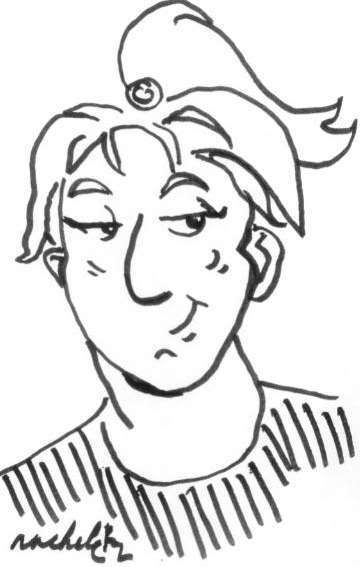
switching back and forth between his comments and mine has no doubt confused and frustrated some of you. Therefore, from here on I'll be posting Kevin's comments--uninterrupted by me--in the form of a column called "Kevin's View." My answer will follow, in a section called "Rachel's Response"--also uninterrupted. You'll no doubt notice some other interesting changes. Whenever possible, pictures will be included to illustrate certain scenes we're discussing, whether stills from films or sketches by me. You'll also get to see, for the first time, what my "mysterious" friend Kevin looks like. He has given me permission to post his image--taken from his Cartoon Network stint--on the blog as his column header. With that, I'll let Kevin take it from here...

Happy 'Tooning,
Rachel Newstead


Ah yes, the full outline of BOSKO'S EASTER EGGS was a fine enough surprise, the next best thing to having all nine BOSKO cartoons out on a comprehensive DVD set complete with commentary tracks--but isn't that what you are trying to do with this blog-give a kind of "commentary" on the cartoon while supplying descriptions of elements in each scene that are striking to the eye and should indeed be noted as people watch for the first or umpteenth time?

It is indeed interesting that both Bosko and Honey do show a great deal of personality in their body language and in the way the scenes are paced. This sort of experimental characterization is, perhaps, what might bug people about the HAPPY HARMONIES and,especially, the very expensive, expansive animation of the duo when they returned to MGM in1939, creating cartoons at MGM' s cartoon studio instead of their own, but it is true that the BOSKO toons are speedier than, perhaps, the entirety of the remainder of the HAPPY HARMONIES put together, although the Ising-directed TWO PUPS cartoons come in a close second in cartoons such as PUPS PICNIC and WAYWARD PUPS.

In BOSKO'S EASTER EGGS we certainly do get the best of both worlds here. We get the frantic hints of cartoon license with characters zooming this way and that in pop-eyed takes or trading dialogue as if we' d truly believe that the characters onscreen were merely drawn over live action footage of kids acting out each moment. Harmon &Ising liked using the "dissolve" a great deal more than most cartoonists. They liked using it instead of a camera pan across to the characters who would be in the same scene, whereas animators in other studios, including Disney, might just have the camera pan across to reveal something ominous approaching left or right of what was going on center-stage in the previous moment. Whether this was done as a time-saving chore or not, it is an odd visual to use.

Most of the time, such dissolves were used to represent passing time, but Harmon and Ising useit to give us the impression of how many things are going on at the same time in the same place, kind of like how the eye moves about a live stage as one scene begins taking our attention away from the previous moment of interraction. This effect has always gotten me thinking that, by now, we would have created an animated feature using multiple screens so audiences do get more of a dimension out of the images all around us. Why I was the only one, or so it seems, who got this idea is a real curiosity to me!

From reading this description, I also get the feeling that this is one of those few HAPPY HARMONIES in which two or more characters are interacting onscreen, a rare occurrence in decades hence as the effect certainly costs a great deal more to do, and I don't know what it takes for animators to synchronize the moves of two characters timing in a given scene together!! This may have led to some folks believing that Harmon or Ising used rotoscoping more than we suspected initially. There are some harmon/ising cartoons that bounce uncomfortably between total realism and cartoonishness, but there are others in which the link between the real and the surreal is startlingly accurate and the BOSKO cartoons are perfect examples of this, as you've outlined in earlier reviews.

It also should be pointed out that this cartoon is ultimately a cartoon about country kids living in farm areas where eggs were the source of food and vegetables grown from the ground also ended up on family tables. So barnyard gags like these went on all the time both in
real life and in so many cartoons that were inspired by farm living from day to day and, judging from the bulk of Harmon/ising cartoons of any age, I get the impression that the guys grew up in that environment.

So, at times, when compared to the SILLY SYMPHONIES, cartoons like this not only
work in showing an amazing range of character development, unfortunately at the point in which some characters were almost being phased out instead of further developed in future cartoons,
this ranks right up there among Disney' s best of this period. Although this is a HAPPY
HARMONIES title, usually full of cute little songs and singing animals or humans, this is clearly a situation comedy of sorts, making me wonder just what these characters would have been
capable of if used again when the duo returned to MGM after 1939. Let\rquote s not forget that
there were OUR GANG comedies to inspire the guys back then, and Hal Roach\rquote s
comedies were also at their peak, with some of the kids quite adept at pantomime and
double-takes of their own, even sometimes enhanced by animation to give the take that surreal edge within the live action framework.

As I've stated, you should read the Leonard Maltin/Richard Ban book, OUR GANG, THE LIFE AND TIMES OF THE LITTLE RASCALS to see what I mean. Read the full description of THUNDERING FLEAS for example, and then read through my outline of CIRCUS DAZE\rdblquote as found and dimly remembered on bcdb.com. I tend to think that CIRCUS DAZE was a cartoon only because one could not possibly put such situations into live action without people or animals getting seriously hurt!!

Lastly, I do, like you, wish that Honey continued on into the BOSKO TRILOGY, as we fondly have called the last three BOSKO musical titles with the jazzy frogs of THE OLD MILL POND and SWING WEDDING. Retaining Honey could have inspired many a musical number, like a jazzier Darla hood or something. The possibilities boggle the mind in retrospect! Makes me wonder why the duo weren't thinking with such clarity if I do say so myself.

Certainly BETTY BOOP cartoons had almost the same situations with Betty always launching into song even as she found herself in peril, and we loooved her for it. I wanted Honey to have as many delicious qualities about her, albeit more like Darla Hood, as I said, than curvaceous Betty. And they had enough talented kids at the studio at the time to give Honey just the right amount of everything I' ve outlined here. It is nice that you again point out Honey' s chattering in surprise, awed by every moment in a given scene, adding something wonderful to her character. I love the moment in which she is going on about how beautiful the newly born chicks look ("d'ere' s a green one an' a blue one an'...d' ere' s one all polky-dotty...") It is a character trait that not only toys with dialect but defines a certain part of this country very clearly. It is that type of humor so misunderstood today and misused by those who wish to stereotype rather than understand its source of inspiration.

RACHEL'S RESPONSE

Kevin's OUR GANG analogy perfectly describes the nature of the Bosko cartoons, as if
Buckwheat had been spun off as an animated character to appear in a series of "adventures" of
his own, but truthfully, the Bosko cartoons transcended race, becoming instead something in which people of any race can find common ground. Perhaps without realizing it, Harman and Ising had unlocked the secret to what made the OUR GANG films so special in the Hal Roach era: "real" stories about "real" kids. While both the Bosko cartoons and the OUR GANG films would climax in cartoonish insanity, the kids seemed like kids, doing the things kids do, if in a somewhat exaggerated way: going to the circus, fending off hostile, recalcitrant creatures both large and tiny, and getting into general mischief, as Bosko did in BOSKO'S EASTER EGGS.

That MGM acquired the rights to OUR GANG in 1938, just a short time after Harman/Ising's days at the studio ended, is a tragedy of missed timing.

The two series would have complemented one another perfectly, with the animated version perhaps looking a bit better in the bargain. Bosko could have gained other kid friends--perhaps a little brother (though I consider the "L'il Ol' Bosko" of the Jazz Frogs Trilogy to be a "little brother" of sorts to the original version) while Honey could have stepped into the Darla Hood role in more ways than just musically. Darla, like most of the girls one saw among the gang, usually existed as a complication to the boys' schemes--disturbing the boys' "paradise" of the He-Man Woman Hater's Club, for instance--and Honey could have adapted to play a similar role. If anything, it might have worked better with Honey, since the character's personality was more clearly delineated than Darla's.

Hugh and Rudy indeed knew the rural sections of the country well, and how rural people behaved. And well they should, as they--like Walt Disney--were Kansas City boys (an aspect I shamefully neglected to mention in Sunday's review).They reveled in bucolic cartoons--whether broad, impossible slapstick like the earliest Oswald and Mickey silents, or gentle with moments of broad humor, as in the Bosko cartoons. Their celebration of nature led to cartoons like THE BLUE DANUBE and TO SPRING, both an explosion of realistic beauty and color. Those who dismiss such cartoons as slow and cloying have to understand Hugh and Rudy's background--they wanted to share the natural beauty they remembered with the public. It's a love that should resonate in the minds of the environmentally-conscious young people of the 21st century. Harman and Ising portrayed a world they feared was rapidly disappearing.

They did go through something of an awkward "adolescence" during their first years at MGM,
shifting uncomfortably sometimes between their earlier, cruder style and the gentler, more
"realistic" one. In some cartoons it actually added to the sense of enjoyment, as shorts like
CIRCUS DAZE shift back and forth between near-realism and bug-eyed cartoony takes. Yet in
films in which they tried to be "serious", as in TALES OF THE VIENNA WOODS, they'd fall on
flat on their faces, as their ambition far outstripped their artistic ability. I've included some
samples here to show what I mean:


In the opening seconds, the view dissolves from an almost perfectly-rendered realistic drawing of a fawn to a rubber-limbed, round-headed, goggle-eyed creature that wags its tail like a puppy. It wouldn't have looked too out of place in a 1932 Looney Tune--in the span of a second or two, we're suddenly back in "rubber-hose" territory, and it comes close to destroying the mood of the film.

During that rough "shakedown" period, they resorted to some pretty ingenious ways to hide any artistic shortcomings. It's no accident that many cartoons from that era featured toys as main
characters, as in THE CALICO DRAGON, THE OLD PLANTATION, and TOYLAND BROADCAST.

The last of the three takes place in the realistic surroundings of a child's bedroom, but one in
which the child is nowhere to be seen. The little girl in the opening moments of THE CALICO
DRAGON by necessity takes up very little screen time, as it was clear they were still not quite
sure how to portray a human child realistically. As one can see from the image I've included, she
seems almost as doll-like as her toys:

By using characters that were meant to be "unreal", such as toys, Harman and Ising could use
characters equally at home in realistic surroundings or worlds of pure fantasy. Once they found
their artistic footing, such devices were no longer necessary; though they did use their ability to
combine the broad with the starkly real in PEACE ON EARTH--a cartoon meant to be emotionally
jarring, yet a fine example of their artistic "maturity."

When Kevin wrote of Harman and Ising's use of the "dissolve" as a storytelling device, I
immediately began to wonder: were they indeed the first to use "montage" in animation (the term I think Kevin was searching for) rather than Frank Tashlin, as generally believed? I couldn't come up with any evidence of their use of such a technique before Tashlin, but they do come close in CIRCUS DAZE. Though in fact, the opening scenes were more a series of rapid successive dissolves than a true montage. We move between nearly-overlapping shots of a
"test-your-strength" meter, to a dishonest hot-dog vendor, to a charging elephant, to a laughing
clown. While not strictly montage, it serves the same purpose--establishing the atmosphere and
the premise quickly so we can get on with the story--yet more proof their cartoons were not
agonizingly slow.

How, then, could anyone say these men lacked creativity, imagination, or humor?


Tags: , , , , , , ,